
Q&A with spokesperson and supporter Beverley Barra-Berger
Beverley Barra-Berger (better known to most folks as Bev Berger) has been a spokesperson for and, an enthusiastic supporter of, the Lions Foundation of Canada Dogs Guide for more than 30 years.
The longtime Nobleton resident has travelled across Canada speaking at seniors’ residences and schools as well as to church groups, scout troops, service clubs and anyone else who is interested in learning about the dog guide program, which assists people with disabilities and certain medical conditions.
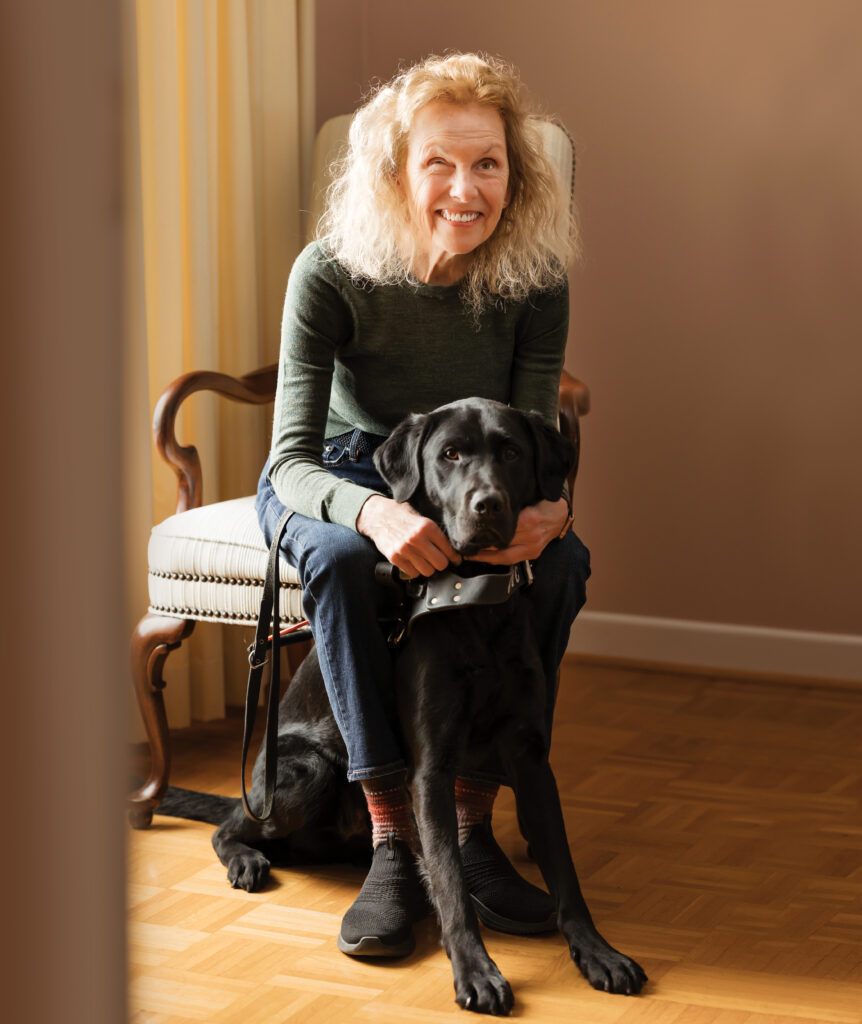
Barra-Berger has raised tens of thousands of dollars through the annual Walk for Dog Guides, which she has participated in for 37 years.
Barra-Berger was honoured for her efforts in 2001 when she was awarded a Governor General’s Caring Canadian Award (now known as the Sovereign’s Medal for Volunteers).
HOW DID IT BEGIN?
Barra-Berger, has been totally blind since 1982 as a result of detached retinas. She got involved with the program in 1989 after an encounter with members of the Nobleton Lions Club.
They were selling raffle tickets at a local plaza and spotted her walking with her tell-tale white cane.
They approached her and told her about the nascent program, which provides dog guides, at no cost, to people with low vision or blindness. Then a group of club members followed up by visiting her house.
“About five or six local Lions showed up at my door, they were all very proud and very excited,” she said.
She filled out the application and a short while later, Barra-Berger found herself at the dog guide training facility in Oakville. The centre had been established a few years earlier by the local Lions Club in a former school so Canadians wouldn’t have to travel to the U.S.A. to get a dog guide.
Barra-Berger soon had her first dog guide — the first of many, it would turn out.
Shortly afterward, the director of the training facility asked Barra-Berger if she’d be willing to help spread the word about the dog guide program.
She happily agreed.
“I was just so thrilled because I felt like somebody had given me the car keys back,” Barra-Berger said. “I was so excited because I could walk down the street by myself, I could go to the post office, I could go out if it was raining or snowing by myself. That was the key, to do it independently, by myself. I didn’t have to rely on somebody else.”
Since then, Barra-Berger has spoken to groups in small towns and cities in nearly every corner of the country about her personal journey and the dog guides program.
Almost every time, she speaks to a group, someone asks, what Barra-Berger calls, the classic question — how do you pick up the poop?
“It doesn’t matter what age group I speak to, whether it’s a bunch of six year olds or a bunch of 90 year olds, they always come right down to that final question,” she said chuckling. “Actually, it’s one of the first things dog guide users learn to do. You learn how to put a bag on your hand, sort of like an oven mitt, bend over and sweep the ground until you find what you’re looking for and grab it.”
HOW DOES THE DOG GUIDE
PROGAM WORK, EXACTLY?
When it started in the mid-1980s, the program had a singular focus, providing dog guides, at no cost, to people who are blind or have low vision.
Today, the Lions Foundations of Canada Dog Guides operates seven programs including Canine Vision Dog Guides, Hearing Dog Guides, Seizure Response Dog Guides, Service Dog Guides (for people with a physical or medical disability), Autism Assistance Dog Guides, Diabetes Alert Dog Guides and Facility Support dogs, who work with agencies that assist people in traumatic situations.
Eligibility varies depending on the program.
For instance, the autism dog guide program is geared toward children (aged three to 12) whereas participants in the vision, hearing and diabetes dog guide programs must be at least 16, but there is no upper age limit.
All the programs involve a detailed application process and those who are selected to take part must go through an interview with a member of the training staff to help them determine which of the specially trained dog guides would be a good match.
(The Lions Foundation runs a breeding facility and a specialized dog training program to ensure they have an ample number of trained dog guides, which are typically Golden Retrievers, Labrador Retrievers or Standard Poodles.)
Following the interview process, participants must go through a training regimen to learn how to work with a dog guide and forge a bond with their dog so they form a good working team.
How that process unfolds also varies.
Depending on the program, participants may have to stay at the training centre in Oakville for up to 21 days to learn “all the rules of the road of handling a working dog,” Barra-Berger said.
WHO PAYS FOR ALL OF THIS?
It requires a lot of time and effort to breed, train and match a dog guide with a recipient, but the Lions Foundation covers all of the costs, which today is about $35,000 per guide dog,
Once a dog goes home, the recipient assumes full responsibility for it including paying the food and veterinary bills,
“You groom it, you work with it, you feed it, you relieve it, you pick up its poop. If you go to the vet, you are the one that picks up the dog, if you’re able to put it on the examination table,” Barra-Berger said, “You don’t get a dog guide then have your family start feeding it and grooming it and relieving it. … It’s a definite reciprocal relationship and it’s a huge responsibility.”
That said, people with limited financial means might be able get a helping hand from their veterinarian, some of whom reduce or waive certain fees, or from a local service club that may, for example, cover the cost of food, Barra-Berger said.
WHERE DOES THE FOUNDATION GET ITS FUNDING?
The Lions Foundation has never received government funding, Barra-Berger said, so support for the dog guide programs comes through public and corporate donations as well as financial support from Lions Clubs and other service clubs, Barra-Berge said.
The biggest fundraiser initiated by the Lions Foundation is the annual Walk for Dog Guides, which takes place May 25 and is celebrating its 40th anniversary.
HOW CAN PEOPLE SUPPORT THE PROGRAM?
Barra-Berger said there are several ways you can help support the dog guides program including taking part in the Walk for Dog Guides, sponsoring someone who is taking part, making a direct donation to the Lions Foundation of Canada Dog Guides, which many people do in memory of a friend of family member who loved dogs.
You can also make a donation to your local Lions Club and ask them to direct it to the Lions Foundation of Dog Guides.
WHAT HAS THE DOG GUIDES PRGRAM MEANT TO YOU?
Barra-Berger says being a dog guide recipient has been a transformational experience.
When she’s out and about, people often approach her because they want to meet her dog and that opens up a unique opportunity, she said.
“It changes the level of your disability when you’ve got a dog guide,” Barra-Berge said.
“It doesn’t matter whether you have hearing ear dog or you’re in a wheelchair or you’re an autistic child, the general public tends to approach your dog first then they realize the person who is attached to the dog has a disability but they’re a person. That’s the key to the whole thing — you’ve got a disability, but you’re a person first. It changes the way people look at someone with a disability in a huge way.”
Being a dog guide recipient has also given Barra-Berger a level of independence she wouldn’t have been able to enjoy otherwise.
“It’s such a great feeling to walk with the dog and know I have the freedom to explore my community and be part of Canada, really, on a different playing field because I’ve got this dog,” Barra-Berger said.
“The Lions Foundation of Canada Dog Guides has given me that privilege and opportunity.”
To find out more about the Lions Foundation of Dog Guides, visit www.dogguides.com. For information about the Walk for Dog Guides, go to: www.walkfordogguides.com