
In the rolling hills and quiet woods of Mansfield, Patricia Vega is crafting a world where art, science, and nature merge in sunlit harmony.
A visual artist, graphic designer, and educator with more than three decades of experience, Vega’s work is a tapestry woven from her Argentine roots, technical mastery, and a reverence for the natural world.
At the centre of her creative practice is an ancient photographic technique reimagined for modern times: cyanotype
Vega has a Bachelor of Fine Arts in Printmaking from the National University of Cuyo in Mendoza, Argentina. Since launching her career in 1990, she has exhibited across Canada and abroad.
Yet it is in her Mansfield studio where her artistic voice continues to evolve – deliberately and brilliantly in blue.
Her latest body of work, titled Bohemian in Blue, celebrates the cyanotype process, a 19th-century photographic method first developed by astronomer John Herschel.
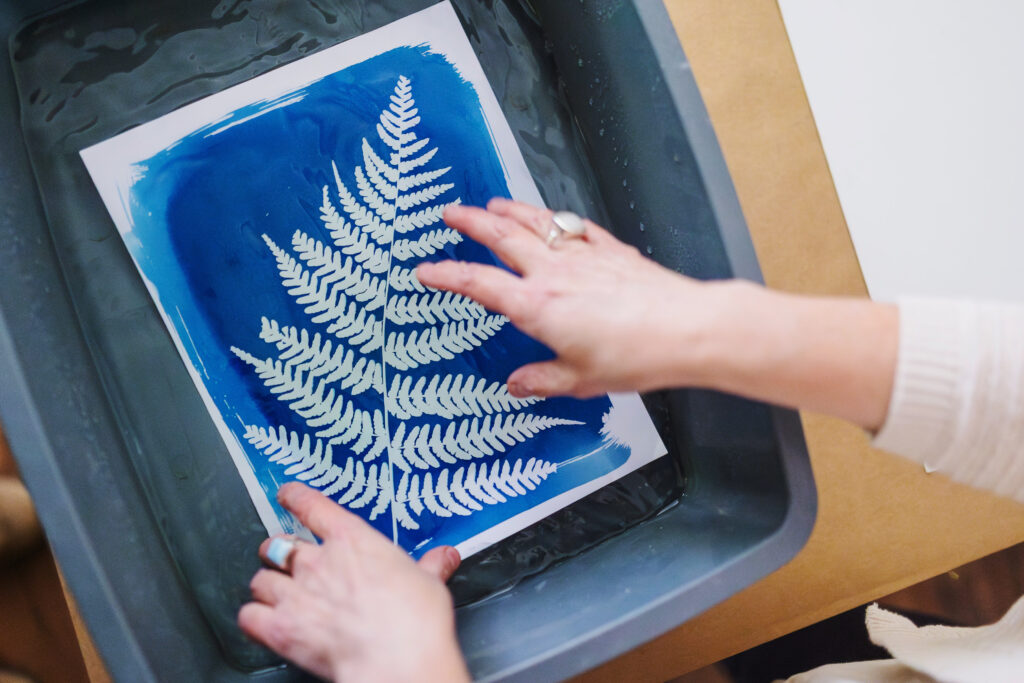
Traditionally used for scientific documentation and engineering blueprints, cyanotype involves coating paper or fabric with a light-sensitive solution. Once exposed to UV light (typically sunlight) the treated surface transforms into a vivid blue image, while the areas shielded from light stay white.
The result is a striking monochromatic print, steeped in contrast and clarity.

For Vega, this isn’t just a process – it’s a ritual.
Each print begins for her by gathering materials: wildflowers, ferns, leaves, and other botanicals sourced from the surrounding landscape.
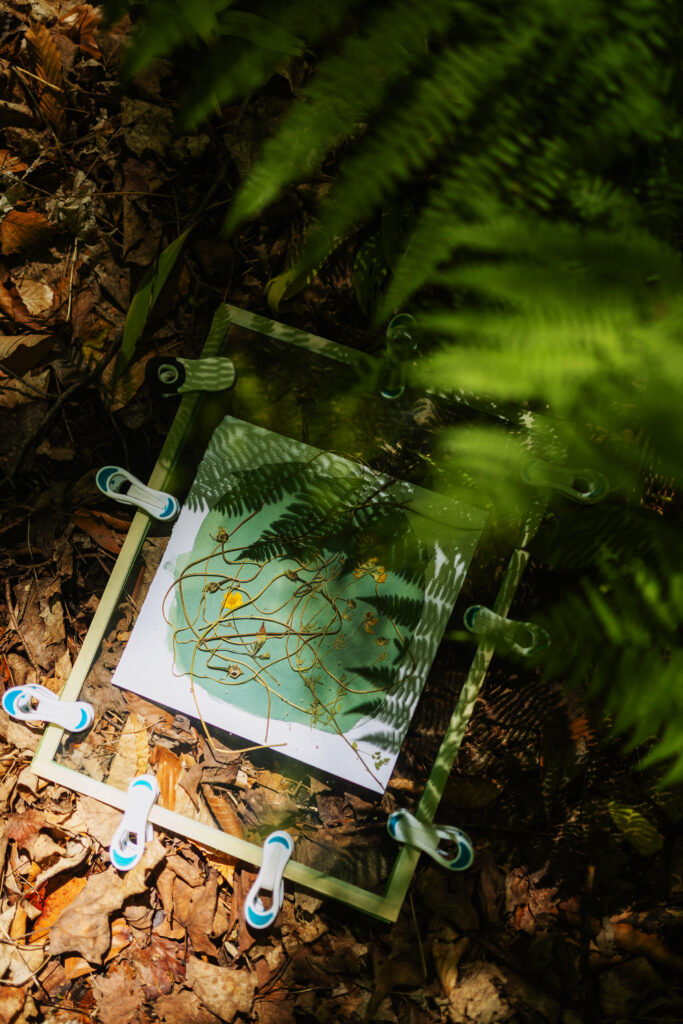
These items are arranged with care on sensitized paper or textiles, secured beneath glass, and left to bask in the sun.
Exposure times vary from minutes to hours, depending on the light, the season, and the desired outcome.
The process ends with a water rinse that reveals the final image – an unveiling Vega described as both meditative and thrilling.
“There’s something magical about this monochromatic effect,” Vega said. “It makes your eye wander and find beauty and peace through the powerful colour.”
But Vega’s cyanotypes aren’t bound by tradition.
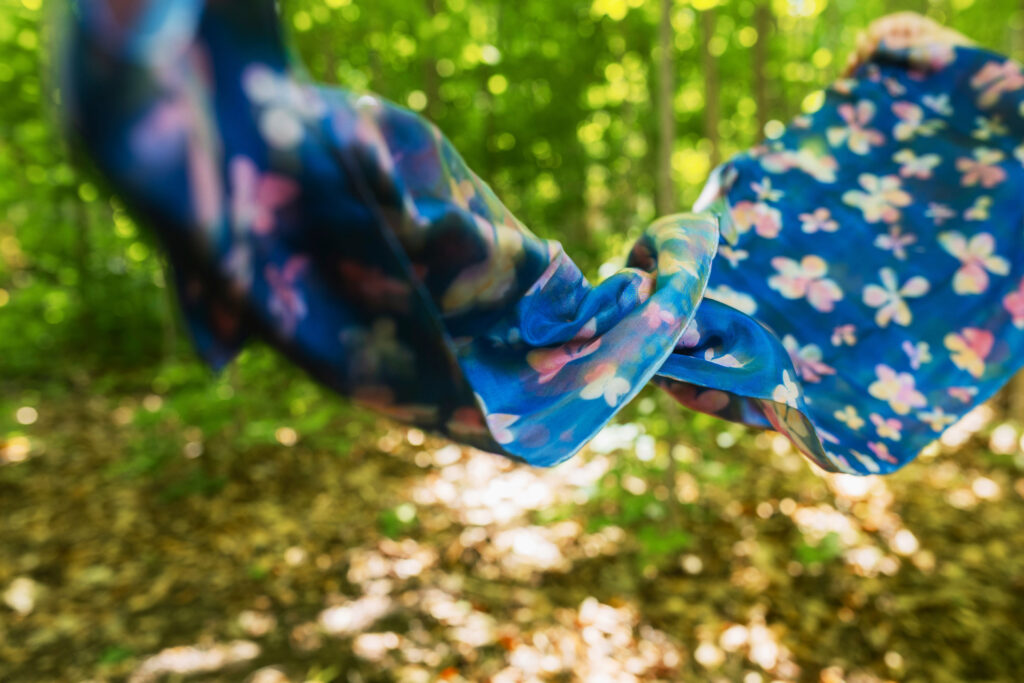
She pushes the limits of the medium, incorporating subtle hues, layering techniques, and mixed materials to create depth and movement. From hand-printed cards and delicate silk scarves to intricate works on Japanese and watercolour papers, each piece becomes a unique expression of time, place, and transformation.
She often experiments with double exposures and complex compositions, adding feathers or transparencies to evoke, “unexpected narratives.”
The unpredictability of the process is part of its charm – no two prints are alike. Even the same composition, exposed on different days or in different light, becomes a new experience.
For Vega, cyanotype is a ritual of transformation.
“It unites the four classical elements, sunlight activates the chemistry, water reveals the image, air mingles with light, and the earth contributes its textures and forms,” she said.
Through this process, she discovers a universal visual language – one that expresses itself through contrasts of light and shadow, presence, and absence.
“It is at once a meditation, a scientific experiment, and a poetic dreamscape,” she said.
In Vega’s hands, cyanotype is not just an art form—it’s a language. And it is unmistakably hers.
To learn more about Vega and her work, visit her website at: www.patriciavega.ca
Find her on social media: @patriciavega_printart